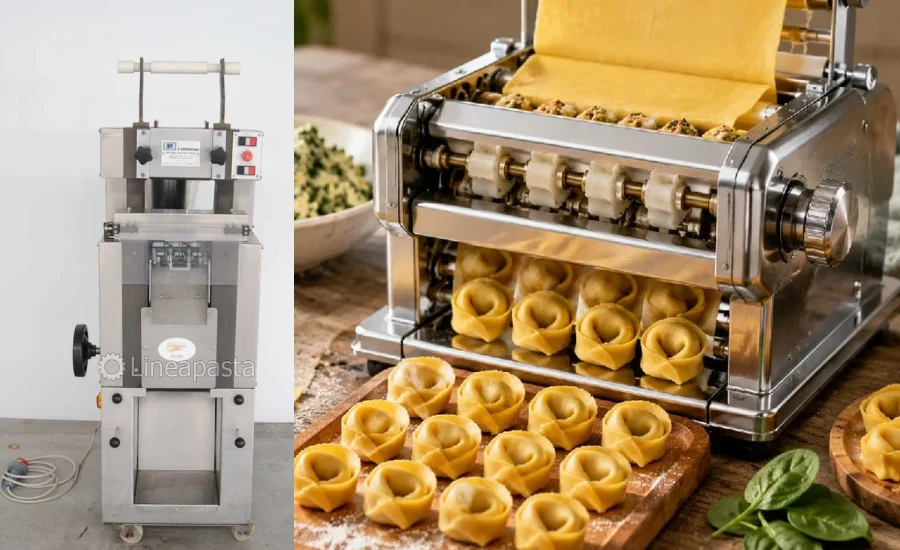
Tortellinatrice is an Italian term that refers to a specialized machine used for producing tortellini, a traditional ring-shaped pasta originating from Italy. These machines are commonly used in commercial pasta factories, restaurants, and food production facilities to automate the process of shaping, filling, and sealing tortellini. By increasing production speed and maintaining consistent quality, a tortellinatrice helps manufacturers meet large-scale demand while preserving the pasta’s traditional appearance.
Modern tortellinatrice machines are available in both semi-automatic and fully automatic models and can handle different types of dough and fillings, including meat, cheese, and vegetable mixtures. They are an important part of the food-processing industry, particularly in Italy, where tortellini is a popular culinary specialty. Advanced models often include adjustable settings for pasta size, filling quantity, and production capacity, making them suitable for businesses of various sizes.
What is Tortellinatrice?
A tortellinatrice is a specialized machine designed to produce tortellini, the traditional stuffed pasta that originated in Italy. The machine automates the process of shaping pasta dough, adding fillings such as meat, cheese, or vegetables, and sealing the pasta into its characteristic ring shape. Tortellinatrici are widely used in pasta factories, commercial kitchens, and food-production facilities to increase efficiency while maintaining consistent quality and appearance.
Modern tortellinatrice machines range from small semi-automatic models for artisan producers to fully automated industrial systems capable of producing thousands of tortellini per hour. They help reduce manual labor, improve production speed, and ensure uniform size and filling distribution. In Italy’s pasta industry, the tortellinatrice plays an essential role in preserving traditional pasta-making techniques while meeting modern production demands.
Read More: JoinMyQuiz
What the Word Actually Means
Start with the linguistics, because this part checks out cleanly. Tortellinatrice is built from tortellini plus the Italian suffix -atrice, the feminine form used to name machines that perform an action — the same pattern behind lavatrice (washing machine, from lavare, to wash) and affettatrice (slicer, from affettare, to slice). A tortellinatrice is, transparently, a “tortellini-maker.” It isn’t a term invented for SEO purposes; it’s standard trade nomenclature, independently used by multiple unrelated Italian equipment manufacturers to describe the same category of machine.
What the Real Machine Does
Strip away the marketing language and the actual mechanism is straightforward. A sheet of pasta dough is rolled to a calibrated thickness, a metered amount of filling is deposited onto it at regular intervals, a second guide folds the dough over the filling, and a forming-and-cutting station seals and separates each piece into the familiar ring shape before it’s ejected onto trays. It’s a continuous, repeatable production line condensed into one footprint built to replace the hand-folding work traditionally done by sfogline, the pasta makers of Emilia-Romagna, at a scale no single person could sustain through a full restaurant service.
It automates rolling, portioning, sealing, and cutting the steps that would otherwise require hand folding at a pace no kitchen brigade can hold for an entire service.Paraphrased from manufacturer product literature, see Transparency Report
Who Actually Builds Them
This is not a hypothetical product category. It’s a small, established corner of Italian food-machinery manufacturing, concentrated unsurprisingly near the dish’s home territory.
- Officina DEA manufactures continuous-feed tortellini lines, including named models like the D140 and D250, alongside ravioli and cappelletti forming machines.
- Facchini Impianti Srl produces dedicated tortellini-forming units such as the TA540-S.
- Lineapasta sells automatic tortellini and cappelletti machines with published technical specification sheets.
- Aldo Cozzi, a fresh-pasta equipment manufacturer operating since 1973, supplying pasta factories directly.
- Belvisi Pasta Machine produces filled-pasta forming machines for industrial-scale ravioli, cappelletti, and tortelloni production.
None of these companies describe their machines as kitchen novelties. They publish them as industrial and semi-industrial equipment, priced and engineered for commercial throughput.
The Numbers Real Spec Sheets Use
The clearest evidence that this is B2B equipment, not a kitchen accessory, is in the technical data published by the manufacturers themselves.
- 25–50kg of pasta/hour, per model
- 380V three-phase industrial motors
- 24V low-voltage safety circuits
- < 80 dB-rated sound emission ceiling
- 1973, the earliest manufacturer was founded
A 380-volt three-phase line and a sound-emission rating are not specifications you’d find — or need — on anything sold for a home countertop.
Where the Dish, and the Trade, Come From
Tortellini’s roots sit firmly in Emilia-Romagna, particularly Bologna and Modena, where the ring shape carries its own regional folklore. The hand-folding tradition behind it is genuinely old and genuinely skilled — which is exactly why the equipment built to scale it became its own manufacturing niche in the first place, rather than something stitched together for a marketing page.
Three Real Categories of Machine
Manufacturer literature consistently splits the market into three tiers: manual crank-fed units for small, controlled batches; semi-automatic machines that hand-feed dough while automating filling and shaping, aimed at boutique restaurants; and completely automated continuous-feed systems designed for factories and pasta labs that operate multi-hour production shifts. That’s a coherent, verifiable taxonomy and notably, it’s one of the few structural details the SEO content layer borrowed accurately, likely because it’s hard to invent a wrong version of three obviously-named tiers.
Exhibit A The Site Built Entirely Around One Term
The domain tortellinatrice.com reads, at first glance, like a dedicated pasta-equipment resource. It isn’t. Its front page also runs unrelated “feature” stories on coach charter services in Chicago, restaurant branding tactics, and climate-disclosure compliance software for the Australian market published in the same months as the tortellinatrice piece. A site that’s simultaneously an authority on Italian pasta machinery and ESG compliance software isn’t a specialty blog. It’s a template publishing whatever currently ranks.
Exhibit B The Recipe Blog With a Split Personality
The domain manicotti.co presents as a straightforward Italian-American recipe site — and most of it is exactly that. But its archive, from the same several-week window, also includes an article on a pulsed electromagnetic joint-pain therapy device and another on the “spiritual significance” of black obsidian, sitting beside cinnamon-pecan recipes and the tortellinatrice piece. Recipes, medical devices, and crystal healing on one byline-free blog is a recognizable shape: programmatic content built to capture whatever keyword cluster is available that week, not editorial judgment about what a food audience wants to read.
Exhibit C The Same Article, Different Costume
Two more domains fashionstorydress.com and a site otherwise dedicated to safety equipment host versions of the same piece, opening with near-identical “imagine a dinner table” hooks and the same “five reasons you need this” structure as the others. Neither domain has any apparent connection to pasta, Italian cooking, or kitchen equipment. The likeliest explanation isn’t four independent food writers reaching the same conclusions; it’s one template, reused across a network of unrelated domains chasing the same search traffic. Evidence Locker tap an exhibit04 sites on filetortellinatrice. commanicotti.cofashionstorydress.com/safety-device site
“Tortellinatrice “
Front page mixes the pasta-machine piece with unrelated posts on charter bus services, restaurant branding, and ESG compliance software. No named author. Generic, unverified social links in the footer.No coherent editorial identity, keyword-of-the-week publishing pattern
“Tortellinatrice” (archived under recipe tags)
Genuine recipe content sits alongside a joint-pain therapy device review and a crystal-healing explainer, published within roughly two weeks of each other. Topically incoherent archive signature of programmatic SEO
“5 Reasons Why You Need a Tortellinatrice”
Domain name and prior content have no link to food or kitchen equipment. Structure and phrasing closely mirror Exhibit A.Templated reuse across an unrelated domain
“Tortellinatrice: Make Perfect Homemade Pasta Easily”
A site otherwise built around safety devices hosts a pasta-machine buying guide with the same beats as the other three: history, types, benefits, and FAQ. Same template, fourth unrelated host domain
The Tell-Tale Phrasing
Beyond the topical mismatch, the writing itself carries fingerprints. Sentences slip into broken grammar mid-thought one listing describes the machine’s ejection step as something “she ejects smoothly,” abruptly gendering the appliance, and another garbles its own cutter description into a phrase that doesn’t parse in English at all. Across all four sites, the same rhetorical hooks recur almost verbatim in structure if not in exact wording: a scene-setting “imagine a dinner table” opener, a numbered “types of machine” breakdown, and a closing “endless culinary possibilities” flourish. Real trade writers describing real equipment don’t independently converge on identical essay skeletons. Templates do.
Why an Industrial Machine Became a “Kitchen Gadget”
This is the central distortion in the case. The actual manufacturers sell three-phase, food-factory-grade machinery measured in kilograms per hour throughput. The content layer built around the keyword instead pitches it as something for a “Sunday craving,” dishwasher-safe and beginner-friendly. That’s not a simplification, it’s a category swap, done because “kitchen gadget” content captures far more shopping-intent search traffic than “industrial forming equipment” ever would. The keyword stayed the same; the product it was attached to changed shape to fit the audience the content was actually written for.
The Social Proof That Isn’t
Every farm-site footer in this case links to social icons and every one of them points to the bare platform homepage (facebook.com, instagram.com, linkedin.com) rather than an actual branded profile. That’s not an oversight; it’s a template field nobody bothered to fill in, because no real brand, audience, or following exists behind these sites to link to.
What Real Industry Presence Looks Like, By Contrast
The genuine manufacturers named in Exhibit 04 don’t run social-first marketing this is B2B trade equipment, sold through catalogs, technical spec sheets, and direct manufacturer relationships, not Instagram. But what they do have is consistent: company names that have operated for decades, named product model numbers, published technical documentation, and direct contact channels for buyers. That’s the actual “social proof” structure for this trade durable institutional presence and it’s the one thing the SEO layer never tries to fake, because it can’t be templated.
Verdict
Closing this file: the word checks out. Tortellinatrice is a legitimately formed Italian trade term naming a real, decades-old category of pasta-forming equipment, manufactured by real companies and sold into real commercial kitchens. What doesn’t check out is the layer of content currently dominating search results for it a minimum of four unrelated domains running a shared template that misrepresents industrial equipment as a home kitchen impulse-buy, padded with invented detail, broken grammar, and social links that lead nowhere. Real term. Synthetic web around it. Case stays open for monitoring as new domains pick up the template.
Transparency Report
Per standard Keyword Forensics protocol, every factual claim above the fold in this file is checked against its source. Below: representative phrasing pulled from the SEO content cluster, alongside the verified version used in this report.
Unverified claim: Framed as a general-purpose home kitchen appliance suited to casual weekend cooking, with no mention of voltage, throughput, or commercial context.
Verified: Manufacturer spec sheets show 380V three-phase motors and 25–50kg/hour throughput — consistent with restaurant and factory use, not home kitchens.
Unverified claim: Presented as a single coherent brand (“Tortellinatrice”) with an editorial mission and social following.
Verified: No named author, registered company, or active social profile could be confirmed behind any of the four domains in this case.
Unverified claim: Implies the term and the appliance category were created or popularized by the publishing site itself.
Verified: The term and the machine category predate every site in this cluster, attested independently by at least five unrelated equipment manufacturers.
Unverified claim: Describes the machine’s mechanical action with first-person, sensory language suggesting hands-on product testing.
Verified: No evidence of hands-on testing; mechanical descriptions are generic enough to apply to any forming machine and contain internal grammatical errors inconsistent with first-hand use.
Also More: Fascisterne
FAQs
Is “tortellinatrice” a real, legitimate word?
Yes. It’s a standard Italian trade term formed the same way as lavatrice (washing machine), tortellini plus the machine-naming suffix -atrice. Multiple unrelated equipment manufacturers use it independently to describe the same machine category.
Can I actually buy one for my home kitchen?
Smaller manual and tabletop semi-automatic units exist and are sold to small operators, but the machines named in manufacturer literature are predominantly commercial equipment three-phase motors and kilogram-per-hour throughput aimed at restaurants and pasta labs, not casual home cooking.
Why do so many articles describe it identically?
This investigation found at least four unrelated domains running a shared content structure same opening hook, same section order, same closing language strongly suggesting a single reused template rather than independent reporting.
Is tortellinatrice.com a real pasta equipment company?
No evidence of that was found. The domain also publishes unrelated content on coach travel, restaurant branding, and compliance software, with no named author or verifiable company behind it.
Does this mean tortellini itself is some kind of internet hoax?
Not at all. Tortellini and the equipment used to produce it are well-documented and rooted in Emilia-Romagna’s culinary history. Only the recent wave of “gadget guide” content built around the keyword is in question here.
Who actually buys and uses these machines?
Based on manufacturer materials: pasta factories, restaurant kitchens, catering operations, and culinary schools commercial and semi-commercial settings, not households.
Final Words
Tortellinatrice is a real and legitimate Italian term used to describe specialized machines that produce tortellini on a commercial scale. These machines play an important role in pasta factories, restaurants, and food-production facilities by automating the processes of shaping, filling, sealing, and forming tortellini while maintaining consistent quality and efficiency. With models ranging from semi-automatic units to fully automated industrial systems, tortellinatrici help preserve traditional Italian pasta-making methods while meeting modern production demands.
At the same time, much of the online content surrounding the term can be misleading, often presenting industrial pasta equipment as simple home kitchen gadgets. While smaller tabletop versions do exist, most tortellinatrice machines are designed for professional use and feature industrial-grade specifications. The term itself is authentic and well-established within the food-machinery industry, but readers should rely on verified manufacturer information and technical documentation rather than generic SEO-driven articles when researching these machines.