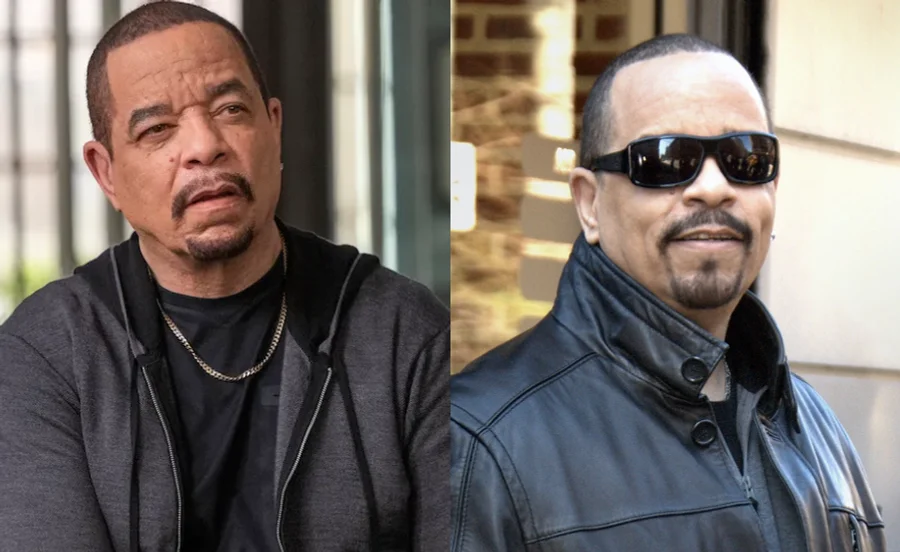
Ice T, born Tracy Lauren Marrow on February 16, 1958, in Newark, New Jersey, had a childhood shaped early by loss and instability. By the age of 12, he had lost both parents, his mother to a heart attack when he was around eight, and his father just a few years later, leaving him to navigate life as an orphan.
Later, he relocated to South Central Los Angeles to live with his family in the Crenshaw district, which is heavily influenced by gang culture. While he never formally joined a gang, the environment around Crenshaw High School exposed him to street life at a young age, shaping his understanding of survival, discipline, and identity.
| Real name | Tracy Lauren Marrow/ Ice T |
| Born | February 16, 1958 |
| Birthplace | Newark, New Jersey, USA |
| Age (2026) | 68 years old |
| Nationality | American |
| Ethnicity | African-American |
| Height | 6 ft 1 in (185 cm) |
| Profession | Rapper, actor, producer, author |
| Stage name origin | Tribute to author Iceberg Slim |
| Debut album | Rhyme Pays (1987) |
| Breakthrough song | “Cop Killer” (1992) with Body Count |
| Metal band | Body Count (co-founded 1990) |
| TV role | Det. Fin Tutuola — Law & Order: SVU (2000–present) |
| TV record | Longest-running male actor in U.S. prime-time TV |
| Episodes filmed | 500+ (SVU) |
| Episode salary | $250,000 per episode |
| Net worth (2025) | ~$65 million |
| Spouse | Nicole ‘Coco’ Austin (married 2002) |
| Children | LeTesha Marrow, Tracy Jr., Chanel Nicole (b. 2015) |
| Residence | New York / New Jersey |
| Walk of Fame star | 2023 |
| Social media | @icet (Instagram) · @FINALLEVEL (X/Twitter) |
| Podcast | Ice-T: Final Level Podcast |
| Books authored | The Ice Opinion (1994); Ice: A Memoir (2011) |
Despite the chaos around him, Ice-T found direction through education and self-awareness, even graduating from high school with solid academic performance. He often recalled how he would pretend to skip school to avoid peer pressure, only to return and secretly focus on his studies.
That quiet determination became the foundation for everything that came later in his life, from street survival to music, and eventually to a groundbreaking career in hip-hop and television. What began as a life marked by hardship would later transform into one of the most unexpected and enduring success stories in entertainment.
Read More: Madison Alworth Net Worth
Newark to South Central: A Childhood Built on Loss
Tracy Lauren Marrow was born on February 16, 1958, in Newark, New Jersey. His father, Solomon, and his mother Alice were working-class, quiet, and present until they weren’t. His mother died of a heart attack when Tracy was around eight years old. His father followed four years later, also from a heart attack, leaving Tracy as an orphan before he even reached his teenage years.
Did you know both of Ice-T’s parents were gone before he turned twelve? That single fact reshapes everything about his story.
After losing his father, Tracy moved to Los Angeles to live with an aunt in the Crenshaw district of South Central, one of the most gang-saturated neighborhoods in the country at that time. He enrolled at Crenshaw High School, where gang affiliations were not just common; they were practically the social structure. Tracy never joined a gang formally, but he was surrounded by members of the West Side Rollin’ 30s Crips. The environment got into him whether he signed up for it or not.
What is remarkable is that he graduated with good grades. He later admitted he would fake skipping class just to sneak back in and actually study, because his friends would have mocked him for caring about school. That particular kind of quiet determination would show up again and again throughout his life.
From the Army to the Streets and Back Again
After high school, Tracy Marrow enlisted in the United States Army, where he served for four years with the 25th Infantry Division. He gained discipline and organization from the military. . It also introduced him to hip-hop. Hearing “Rapper’s Delight” by the Sugarhill Gang for the first time convinced him that talking over a beat was something he could actually do.
When he returned to Los Angeles in the early 1980s, two things happened simultaneously: he started building a name as a DJ and rapper at local parties, and he slid back into criminal activity, robbing jewelry stores, selling stolen car stereos, and running other street-level hustles. He was living two parallel lives, and the question was which one would pull harder.
A 1985 car crash settled it. He was hospitalized as a John Doe because he carried no ID, a precaution against being identified during criminal activity. Lying in that hospital, he made a decision. Two weeks after discharge, he won an open-mic competition judged by Kurtis Blow. The streets had released him, barely, and the microphone caught him.
He named himself Ice-T as a tribute to Iceberg Slim, the pen name of Robert Beck, a former pimp turned bestselling author whose raw, unsparing novels about street life had captivated Tracy since his teenage years. The name was not just a salute. It was a philosophy. Iceberg Slim had taken everything the streets gave him and turned it into something permanent. Ice-T intended to do the same.
The Albums That Rewired an Entire Genre
Rhyme Pays, Ice-T’s debut album, was released in 1987 after he signed with Sire Records. It became the first hip-hop record ever to carry a parental advisory sticker, a label that would later become standard across the industry. That tells you something about what Ice-T was doing before the rulebook existed to cover it.
Did you know “6 ‘N the Mornin’,” released in 1986 before his debut album, is considered by many historians to be the song that lit the fuse for the entire West Coast gangsta rap movement? The track that would inspire Eazy-E, N.W.A., and a generation of Compton artists had Ice-T’s fingerprints all over its DNA.
His second album, Power (1988), was the only solo Ice-T record certified platinum by the RIAA. He also recorded “Colors” that year, the title track for Dennis Hopper’s film about Los Angeles gang culture, which reached audiences who had never stepped inside a rap record store.
The 1989 album The Iceberg/Freedom of Speech Just Watch What You Say pushed even harder, featuring guest vocals from Jello Biafra of the Dead Kennedys, addressing censorship directly at a time when the government was trying to regulate rap music. Ice-T was not rapping about the streets anymore. He was rapping at the people who wanted to silence the streets.
Then came 1991. O.G. Original Gangster arrived and permanently altered the landscape of American music. Critics, peers, and eventually scholars would cite it as one of the defining documents of gangsta rap, not just a style, but a genre with politics, consequences, and its own moral code.
The Song That Made a President Say His Name
1992 was when things got genuinely dangerous, culturally speaking. Ice-T had co-founded a heavy metal band called Body Count in 1990. When Body Count’s self-titled debut dropped in 1992, it included a track called “Cop Killer.” The song was written from the perspective of someone seeking revenge against police brutality. It was visceral, it was metal, and it was aimed directly at an institution.
President George H.W. Bush publicly condemned it. Police organizations organized boycotts. Charlton Heston read the lyrics aloud at a Warner Bros. shareholders meeting to pressure the label. The National Rifle Association, which had recently paid Heston as a spokesperson, deployed its most famous face to fight a rap-metal song.
Ice-T’s response was not to fold. He eventually chose to pull the track himself, voluntarily, but he separated from Warner Bros. on his own terms. He once said, “When the president of the United States mentions your name in anger, you know the situation has genuinely escalated. ” He was right. And he was still standing when it was over.
The Second Act Nobody Saw Coming
By the mid-1990s, Ice-T had started appearing in films. His debut in New Jack City (1991), where he played a police detective, in one of history’s tidiest ironies, launched a screen career. He worked steadily through the decade: Ricochet, Trespass, Surviving the Game, Johnny Mnemonic, and Tank Girl. He was building range.
Then in 2000, Dick Wolf offered Ice-T a role on the newest branch of the Law & Order franchise, Special Victims Unit. He was cast as Detective Odafin “Fin” Tutuola, a streetwise former undercover narcotics officer. The man who once wrote lyrics the White House found threatening was now playing a cop on NBC, and he was going to do it for over two decades.
As of 2026, Ice-T has filmed more than 500 episodes of SVU. According to Deadline, that makes him the longest-running male actor in American prime-time television history. He earns $250,000 per episode, which translates to roughly $6 million per season before syndication. His total SVU earnings alone have crossed the nine-figure mark.
Did you know comedian John Mulaney dedicated an entire segment of his stand-up special New in Town to Ice-T’s role on SVU? Mulaney pointed out that Ice-T’s character seems perpetually shocked by criminal behavior despite working in a sex crimes unit. The observation went viral. Ice-T found it genuinely funny.
He was awarded a star on the Hollywood Walk of Fame in 2023. That is not a minor footnote. That is confirmation from the industry itself.
Social Media, Public Image, and the Unfiltered Online Presence
Ice-T does not do filtered. His Instagram (@icet) and his X account (@FINALLEVEL) function as ongoing, unscripted commentary on everything from politics to pop culture to whatever he is thinking about at 2 am. He posts. He responds. He argues with trolls. He wins.
He launched the “Ice-T: Final Level Podcast” with longtime collaborator Mick Benzo, and it covers SVU behind-the-scenes content, current events, movies, and whatever else is on his mind. The podcast has pulled in dedicated listeners precisely because Ice-T does not perform authenticity; he simply operates that way.
His wife, Coco Austin, maintains her own substantial social media presence, and the two frequently appear together across platforms. When their daughter Chanel Nicole was born in November 2015, Ice-T created an Instagram account for her immediately. Critics pushed back. His response was direct: if you don’t want to see pictures, you don’t have to follow. The account exists. The critics moved on.
His public image is consistent across every platform: direct, funny, occasionally confrontational, always himself. That consistency over four decades of constant media scrutiny is, by itself, a significant achievement.
The Family Man Behind the Reputation
Ice-T married model Nicole “Coco” Austin in January 2002. Their relationship became the subject of the E! reality series Ice Loves Coco, which ran for three seasons from 2011 to 2013 and gave audiences a version of Ice-T that the “Cop Killer” era had not exactly advertised: as domestic, genuinely affectionate, and openly devoted to his wife.
Their daughter Chanel Nicole Marrow was born on November 28, 2015. Ice-T also has two children from earlier relationships: a daughter, LeTesha Marrow, and a son, Tracy Marrow Jr.
He has stated on multiple occasions that he does not drink, does not smoke, and does not use drugs. He practices Brazilian Jiu-Jitsu and boxing. He is a committed UFC fan. The man who rapped about every form of excess lives, privately, a disciplined and structured life. That contrast is not a contradiction; it is the point.
Also More: Jynxzi Age
Net Worth, Legacy, and Where He Stands in 2026
Ice-T’s net worth is estimated at $65 million as of 2025, built across music royalties, SVU salary, book deals (The Ice Opinion in 1994 and Ice: A Memoir of Gangster Life and Redemption in 2011), endorsement work including GEICO campaigns, video game voice work in Gears of War 3 and Borderlands 3, and real estate holdings in New York and New Jersey.
What he built is not just financial. He is one of two or three artists credited with establishing the grammatical rules of gangsta rap as a genre. His influence runs directly into N.W.A., Snoop Dogg, and every artist who came after them and treated the street as subject matter worth serious artistic treatment.
He has two NAACP Image Awards for his SVU work. He has a Hollywood Walk of Fame star. He has a metal band that still tours. He has a podcast. He has a daughter with her own Instagram account. He has outlasted every controversy, every career prediction, and every industry that tried to contain him.
FAQs:
1. What is Ice-T’s real name?
Tracy Lauren Marrow. He was born in Newark, New Jersey, in 1958.
2. Why did he call himself Ice-T?
The name honors Iceberg Slim, the pen name of Robert Beck, a former pimp who became an author. Ice-T read his novels as a teenager in South Central Los Angeles and found them transformative.
3. What was “Cop Killer” really about?
It was written from the perspective of someone seeking revenge for police brutality, specifically the kind of police violence experienced by Black communities in Los Angeles. Ice-T and Body Count insisted it was social commentary, not a call to action. President George H.W. Bush disagreed publicly.
4. How long has Ice-T been on Law & Order: SVU?
Since 2000, over 25 years and 500-plus episodes. He plays Detective Odafin “Fin” Tutuola, and he holds the record as the longest-running male actor in American prime-time television history.
5. How much does Ice-T earn per episode of SVU?
Approximately $250,000 per episode, which amounts to roughly $6 million per season before syndication earnings.